
Blog
Recent blog posts
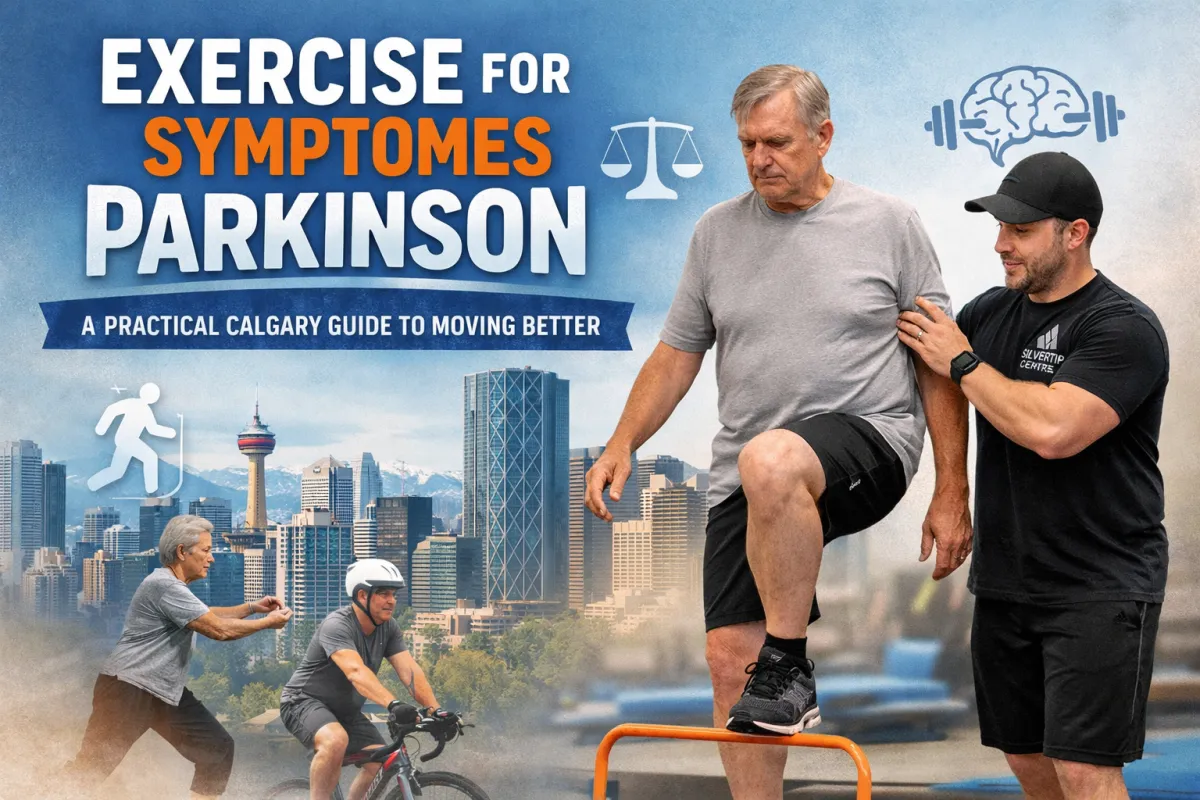
Exercise for symptoms Parkinson: a practical Calgary … guide to moving better Post
If you’re living with Parkinson’s in Calgary (early → mid-stage) and you’ve noticed shuffling, shorter steps, stiffness, posture changes, turning hesitation, or a drop in balance confidence—this guide is for you. Exercise for symptoms Parkinson isn’t about “hero workouts.” It’s about repeatable practice that trains walking, turning, posture, and balance strategies safely so they show up in real life.
At Silvertip Training Centre (Calgary NE), our #1 goal is simple: help you build a consistent, coached routine—starting with a baseline assessment—then plug into Grizzly Strides for weekly structure and progress you can stick to.
What causes the symptoms people notice most in Parkinson’s

Most people don’t come in saying, “I want to exercise more.” They come in saying:
“My steps are smaller and I’m shuffling.”
“Turning feels sketchy—I hesitate or feel stuck.”
“I’m stiff, hunched, and not as steady as I used to be.”
“My balance confidence is dropping.”
Here’s the key: gait (walking), turning, and posture changes are not just “fitness” problems. They’re movement-skill problems that need skill-based practice—with the right cues, the right progressions, and the right safety plan.
That’s why random workouts often miss the mark. You don’t walk better by hoping. You walk better by training stride length, rhythm, posture cues, and turning strategy—on purpose.
What actually works: the Silvertip approach
(and why it’s different)

There’s no single “best” exercise—what matters is what you’ll do consistently. But for Parkinson’s, we’ve learned a lot from real people showing up weekly, not occasionally.
My 3 “hot takes” (Silvertip style)
1) Consistency beats hero workouts.
Parkinson’s responds best to repeatable practice—weekly structure, coached cues, and progress you can stick to.
2) Gait + turning + posture are skills—train them like skills.
We don’t “just move.” We practice stride length, rhythm, posture, and turning strategies until they become your new default.
3) Balance strategies aren’t optional—they’re the independence plan.
We train stepping reactions, weight shifts, controlled transitions, and confidence because that’s what shows up in real life.
The Silvertip priority stack (always)
Gait mechanics: stride length + rhythm + posture cues + direction changes/turning
Balance + stepping strategies: weight shifts, controlled reactions, confidence building
Strength/stability: legs/hips/core for real-life function (sit-to-stand, stairs, steadier walking)
Brain-body / dual-task: cueing, counting, responding while moving (scaled safely)
Mobility + breathing/posture resets
If you want the Parkinson’s-specific version of this structure, start here:
Parkinson’s – Grizzly Strides
What to expect in a session (practical detail)

Most people want to know: “Okay—but what do we actually do?”
A typical week (simple + scalable):
2–3 sessions/week, ideally coached
45–60 minutes/session
Session A: gait + posture + strength/stability
stride length drills + rhythm work
posture cues and “reset” strategies
legs/hips/core patterns that carry over to daily life
Session B: balance/stepping strategies + turning + brain-body
weight shifts, stepping reactions, controlled transitions
turning practice (because turning is where confidence drops fast)
safe dual-task layers (counting/cueing/responding while moving)
Session C (optional): conditioning + mobility + confidence reps
lighter intensity, high-quality reps
mobility + breathing/posture resets
“confidence volume” without fatigue wrecking form
How we scale it by stage (no guesswork)
Early-stage (still active, wants performance + prevention):
More gait/turning reps, more conditioning, more dual-task challenge (still safe).
Goal: keep stride length, rhythm, and confidence strong.
Mid-stage (more stiffness, shuffling, turning hesitation):
More cueing strategies, more turning practice, more balance reactions.
Goal: build a repeatable movement toolkit that shows up at home and in the community.
Advanced / higher fall risk:
More supported work, shorter sets, more rest, tighter supervision, fewer complex layers.
Goal: safer transitions, steadier steps, confidence doing the basics well.
If falls are active or uncertain, we start with an intake first.
For a broader coached option that still focuses on gait, balance, and function, see:
Clinical Exercise Programs
How progress is measured
(Healthy Measures / assessments)
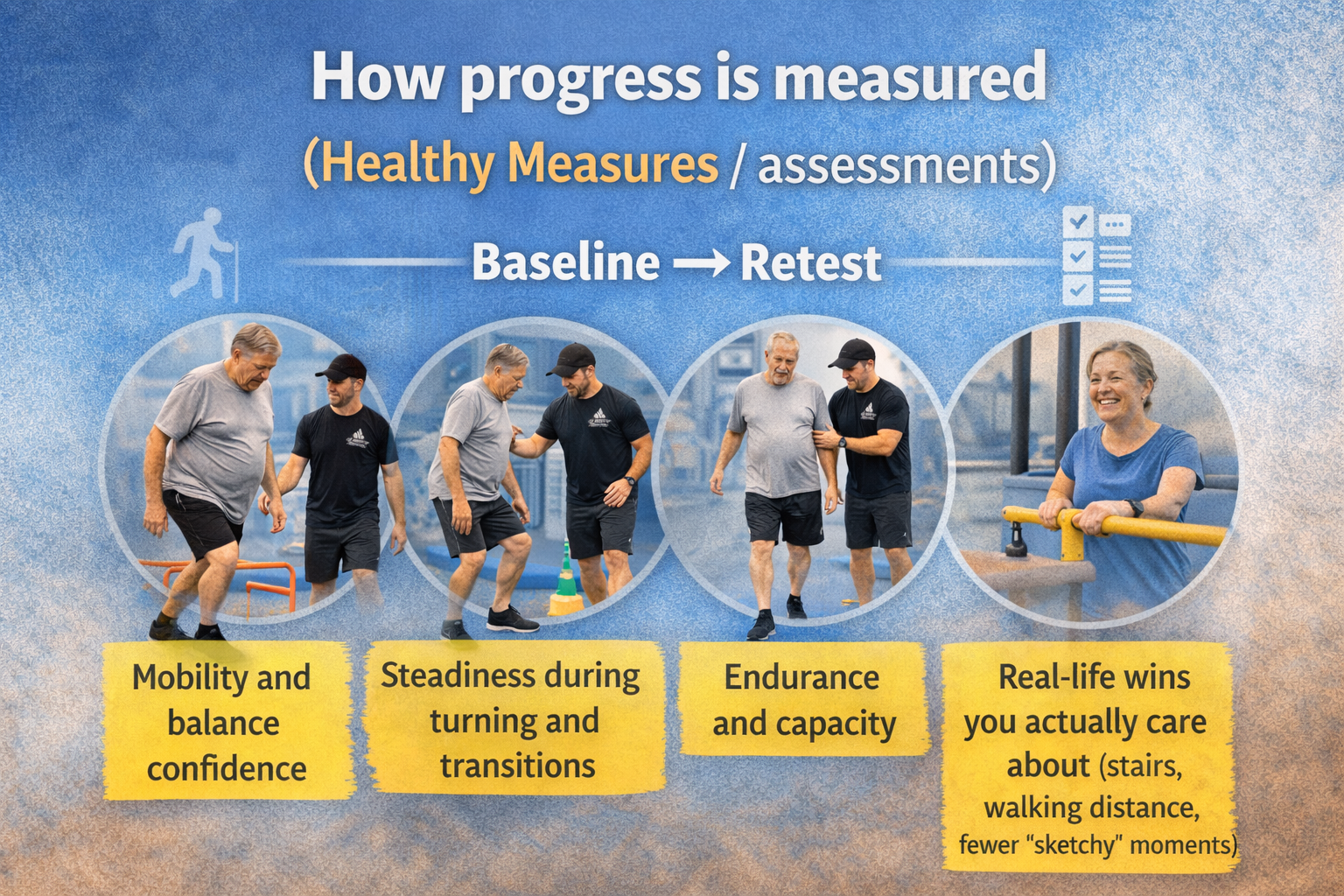
If you want results you can trust, you need a baseline.
At Silvertip, we start with a baseline assessment / intake so we can:
pick the right starting level (safe + realistic),
identify your biggest “movement levers” (gait, turning, balance reactions, strength),
and track progress at 6–12 weeks so you can see what’s improving.
We may use simple, practical measures (educational, not diagnostic) to track:
mobility and balance confidence,
steadiness during turning and transitions,
endurance and capacity,
and real-life wins you actually care about (stairs, walking distance, fewer “sketchy” moments).
Want to start the right way (especially if you’ve had near-falls)? Book your intake through our contact page: Contact Us
FAQs: exercise for symptoms Parkinson (Calgary)

1) What is the best exercise for Parkinson’s symptoms?
There isn’t one “best” exercise. The best plan is the one you’ll do consistently—ideally covering gait practice, balance strategies, strength/stability, mobility, and (safely) brain-body training.
2) How often should I exercise with Parkinson’s?
A simple starting point is 2 coached sessions per week for 6–8 weeks, then build from there. Consistency matters more than occasional hard sessions.
3) Why does turning feel harder than walking straight?
Turning demands coordination, weight shifting, timing, and balance reactions—so it often exposes confidence and stability gaps. That’s why we practice turning as a skill (not an afterthought).
4) Should I exercise during my “ON” time?
If possible, yes. Training during your best movement window usually improves quality and safety—especially for gait, posture, and balance work.
5) What if I’m afraid of falling?
That’s exactly when structure matters most. We start with a baseline intake, scale the challenge, use supports when needed, and build stepping strategies and confidence progressively. If you’re actively falling, intake first.
6) Do I need boxing, dance, or tai chi to improve?
Not necessarily. Those can be great options because they’re skill-based and engaging—but what matters is that your plan includes the key elements: gait, balance, strength, mobility, and safe brain-body challenge.
7) Can exercise “fix” Parkinson’s?
Exercise isn’t a cure, and we don’t promise medical outcomes. What it can do is support function and quality of life—helping many people feel steadier, more confident, and more capable in daily life through consistent practice.
the “real” plan is repeatable
If you take one thing from this: exercise for symptoms Parkinson works best when it’s repeatable, coached, and skill-based. You’re not trying to win a workout—you’re trying to build a movement toolkit that shows up when you’re walking, turning, carrying groceries, getting up from a chair, or navigating a busy sidewalk in Calgary.
Your next step (Silvertip #1 action)
Book a baseline assessment / intake so we can choose the safest starting level and track progress—then join Grizzly Strides for weekly structure and coached results.
Start here: Start Here with Silvertip
Book / ask questions: Contact US
Silvertip Training Centre
Address 1308 40 Ave NE, Calgary, AB T2E 6L1
Phone/Text 403-992-8032
Website https://silvertiptrainingcentre.ca/
Contact Page: Contact us
