
Blog
Recent blog posts
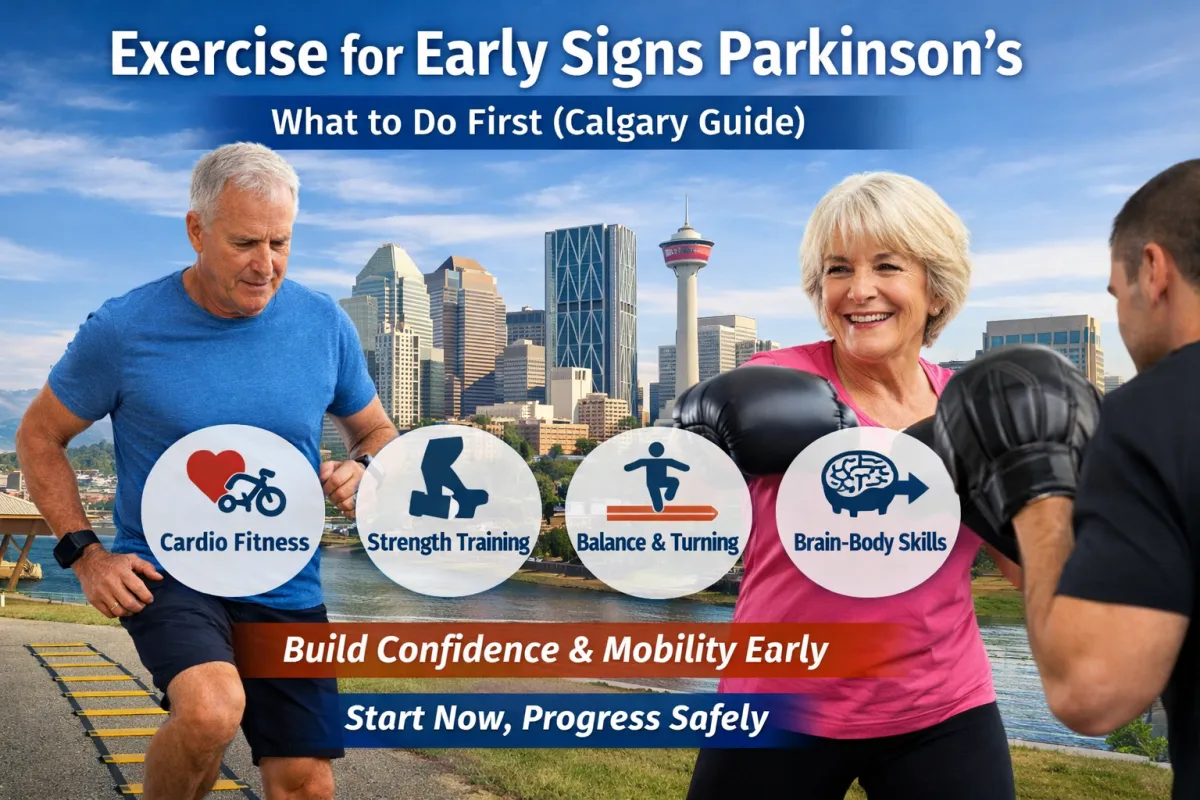
PostExercise for Early Signs Parkinson’s Exercise: What to Do First (Calgary Guide)
If you’re searching exercise for early signs Parkinson's exercise, you’re probably noticing changes you can’t ignore—slower steps, stiffness, smaller movements, reduced arm swing, shakier balance, or less confidence when turning. In Calgary, we see this all the time: people don’t need “harder workouts”… they need better movement practice—coached, structured, and repeatable.
At Silvertip Training Centre, we’re not a generic gym. We run brain + body training built for real-life carryover: walking and turning confidence, posture, balance reactions, strength, and steady routines—especially for adults 50+ and the Parkinson’s community.
What’s going on in the early signs (and why exercise helps)

Early Parkinson’s-related changes often show up as movement quality issues before they become “big” limitations:
Steps get smaller (shuffling)
Turning feels awkward or slow
Posture rounds forward
Balance feels less automatic
Movements shrink (less arm swing, smaller gestures)
Confidence drops, so activity drops (and that’s the trap)
The key is this: the brain and body respond to practice. Research and clinical guidance consistently support that regular exercise can help maintain function, balance, gait, mood, and quality of life—especially when started early and done consistently.
What actually works: the “4-part” exercise plan (and how we coach it)
A smart early plan isn’t random. It’s a mix of four pillars, progressed safely:
1) Aerobic work (heart + lungs)
Think: brisk walking, cycling, or intervals that raise your heart rate without making you feel unsafe. This supports endurance and walking capacity.
2) Strength (legs/hips/core/posture)
Stronger legs + hips + core make everything easier: stairs, getting up from chairs, steadier walking, and better balance reactions.
3) Balance + turning skills (the confidence builders)
This is where early wins happen: stepping strategies, weight shifts, controlled turns, and “catch yourself” reactions—done with coaching and support nearby.
4) Brain-body dual task (done safely)
This is training your real life: thinking while moving (counting, cueing, responding), because everyday movement is rarely “one task at a time.”
This is the Silvertip approach: skills-based movement training with structure, coaching, and progression—so it transfers into daily life.
If you want to see the Parkinson’s-specific program we use for this style of training, start here:
What to expect in a Silvertip session (early-signs friendly)

Here’s what a typical coached session is built around (and why it’s different than “just working out”):
Warm-up + mobility (hips/ankles/upper back) + posture reset cues
Walking + turning drills (stride length, rhythm, direction changes)
Balance strategies (weight shifts, stepping reactions, stability under control)
Strength/stability (functional patterns: sit-to-stand, hinges, carries, legs/hips/core)
Brain-body work (cueing, counting, responding while moving—scaled to your level)
Cool-down + breathing/reset to reduce stiffness and reinforce posture
For many people, the biggest early shift is confidence: walking feels steadier, turning feels less “sketchy,” and you stop avoiding movement. That’s when momentum starts.
Related (50+ brain-body training)
How progress is measured (so you know it’s working)
One reason people quit exercise is they can’t see progress. We fix that with baseline → re-test so you can track real changes.
Depending on the person, we may use tools like:
TUG (Timed Up & Go) for mobility + turning
Balance measures (BEST / MiniBEST) for balance strategies and fall risk signals
Sit-to-stand tests for strength and function
Walking speed / walk time for gait capacity
Real-life wins you actually care about (stairs, outdoor confidence, fewer stumbles, easier transfers)
This is the “Healthy Measures” mindset: train with a plan, track what matters, and progress safely.
FAQs: exercise for early signs Parkinson’s exercise
1) Should I start exercising right away if I’m noticing early signs?
In most cases, yes—start early and start safely. If you’re unsure, begin with a coached baseline screening and a plan that matches your balance and confidence level.
2) What exercise is best for early Parkinson’s symptoms?
The best plan usually includes aerobic + strength + balance/turning + mobility, with some brain-body dual task layered in safely. Variety beats “one perfect exercise.”
3) Is walking enough?
Walking helps—especially if you practice bigger steps, rhythm, posture, and turns. But walking alone often misses strength and balance strategy work, which is where falls and confidence issues start.
4) What if I’m scared of falling?
That’s common—and it’s exactly why balance training should be coached and progressed with support nearby. You don’t “avoid” balance problems by doing less—you build skills and strategies safely.
5) Do I need high-intensity workouts?
Not necessarily. Some people benefit from higher intensity, but not everyone should. If higher intensity isn’t appropriate, moderate intensity done more consistently can still be powerful. Safety and consistency come first.
6) Can exercise replace medication or medical care?
No. Exercise can support function and quality of life, but it’s not a cure and it doesn’t replace medical care. We keep everything safety-first and complementary.
7) How often should I exercise each week?
A strong baseline target used in Canadian guidelines is 150 minutes per week of moderate-to-vigorous aerobic activity plus strength training at least twice weekly—then adjusted to your symptoms, safety, and recovery.
8) What’s the best way to start if I’ve been inactive?
Start small, stay consistent, and get a coached plan. The goal is to finish sessions tired—not exhausted—and build your weekly routine over time.
Early action beats waiting (and routine beats randomness)

If you’re dealing with early changes and you searched exercise for early signs Parkinson's exercise, here’s the bottom line:
Start early
Train the 4 pillars (cardio, strength, balance/turning, mobility + brain-body)
Keep it coached, safe, and progressive
Track progress so you stay motivated
Build a routine you can actually stick with
CTA (pick the one you want to use)
If you want the fastest, safest next step: book a baseline assessment and we’ll map out the right plan for your gait, balance, posture, and confidence.
Business Name Silvertip Training Centre
Address 1308 40 Ave NE, Calgary, AB T2E 6L1
Phone/Text 403-992-8032
Website https://silvertiptrainingcentre.ca/
Contact Page: Contact us
